mmp

  • Subscribe to our RSS feed.
  • Twitter
  • StumbleUpon
  • Reddit
  • Facebook
  • Digg
Showing posts with label 1921. Show all posts

Friday, 21 January 2011

The Three Musketeers (1921)

Posted on 03:21 by Unknown
Fairbanks takes the high ground
Directed by Fred Niblo
Starring Douglas Fairbanks, Léon Bary and George Siegmann
Produced by Douglas Fairbanks Pictures

Young, ambitious D'Artagnan sets off from his small town for Paris to fulfill his lifelong dream: to join the King's musketeers.  Along the way, he runs afoul of Rochefort, the right hand man of the evil Cardinal Richelieu.  D'Artagnan meets musketeers Athos, Porthos and Aramis, challenging them each to a duel, but the fight becomes a battle between the four men and the cardinal's guards.

Meanwhile, Richelieu is plotting against King Louis XIII.  His plan?  To retrieve a diamond buckle that the king gave to the queen, but that the queen gave to the English Duke she's in love with.  If Richelieu succeeds, he'll... um...errr....

Okay, the plot of this movie makes zero sense.  The king gives the queen a diamond jewel, making a point to say that it is one-of-a-kind.  Impossible to reproduce.  The queen immediately turns around and gives it to the duke.  The cardinal witnesses this and, rather than accuse her on the spot, convinces the king to ask the queen to wear the bling to a ball a few days later. So, we get a lots of scenes of the queen wringing her hands and the Cardinal looking very self-satisfied.  It also means our hero can race to England to try and retreive the bauble. 

It's easy to dismiss the story as a meaningless excuse for Fairbanks to be let loose his manic energy, but the film spends a lot of time on the plot.  There are a lot of scenes that exist to communicate the gravity and stakes of the situation.  We see lots of symbolic chess games.  We get lots of characters making bold pledges with massive flourishes of the arms. We get a lot of our villain and our damsel in distress pondering their plans and fates.  We try to build tension as the cardinal's men assemble for the climax while D'Artagnan races toward the city.  So, the story matters and it is nonsensical. 

As for Fairbanks, he is fine here.  Not great, but not bad.  He shines when there are action scenes, but there aren't enough chases and battles in this movie to distract from his poor acting in the other scenes.  He spends much of the movie with this completely earnest look on his face that is just painful to watch.  To say nothing of the fact that he is way too old to play this part.  He looks the same age as the other musketeers, if not older.  That would be fine if they adapted the story to service his age, but they make a point of him being a younger man several times.

The movie works during its inventive action scenes.  I like the swordfight early on between the musketeers and the cardinal's guards.  D'Artagnan's one-on-dozens battle and subsequent escape over Paris' rooftops is thrilling.  And the final fight between our hero and Rochefort feels like an epic precursor to Errol Flynn's The Adventures of Robin Hood climax.

The standout performance here for me was Nigel De Brulier's Cardinal Richelieu.  He never really does anything overtly bad, but one look at the guy and you know he's evil.  You can always see the wheels turning in his head and his eyes relish the moments when he thinks he has won.  I also love the Bond villain like secret door and staircase in his office.

The other notable achievement of the film is in the production design.  The king's halls feel grand.  Paris feels like a lived in place populated by real people, not extras.  The scenes of Fairbanks following a young woman he has just saved through the nighttime streets makes the alleys look menacing and foreboding.

One last thing: the ending for this is silly and not in a good, Fairbanks-y way.  The Richelieu from the previous 98 percent of the movie would never do what he does at the end.  the change in character is ridiculously jarring and sets up a "hey, everything worked out" ending that is really unearned.

At the end of the day, The Three Musketeers is a movie that wants to have it both ways.  It wants to be a zany, comic action-adventure. It also wants to be a palace intrigue thriller.  It accomplishes neither.  It's overstuffed with story and characters and isn't as filled with the Fairbanks brand of boundless energy as his previous work.  And that's a disappointment as I loved Fairbanks' take on Zorro.

**1/2 out of *****

Photo from DVDTalk
Read More
Posted in 1921, douglas fairbanks, the three musketeers | No comments

Wednesday, 19 January 2011

Leaves from Satan's Book (1921)

Posted on 03:39 by Unknown
Jesus, the apostles and a lot of text
Directed by Carl Theodor Dreyer
Starring Helge Nissen (and a lot of other people)
Produced by Nordisk Film

The war in heaven is over and Satan has lost.  As his punishment, Satan is sentenced to tempt humans into evil actions.  If people give into temptation, Satan receives another 100 years of punishment.  However, if they can resist, God will remove 1000 years from Satan's sentence.

Leaves from Satan's Book follows the devil as he attempts to sow the seeds of evil at the time of the Crucifixion, the Inquisition, the French Revolution and the Finnish Civil War.  There is one good movie here, two okay ones and one that is terrible.

The best of the four is the tale during the French Revolution.  As the aristocrats are rounded up, Joseph. a servant of the Count de Chambord, sneaks his master's wife and daughter into Paris to avoid the guillotine.  Joseph is in love with the daughter, but she does not reciprocate his feelings.  Satan, in the form of Erneste, brings Joseph into the Jacobin circle.  Erneste points out to Joseph that he only needs to threaten to expose the lineage of the de Chambords.  Joseph resists, but Satan forges a letter to the Jacobins about the aristocrats and blames it on Joseph.  If the man admits he did not author the letter, he will be led to the guillotine.  If he lies and says he exposed the women, he will be hated forever by the woman he loves.  What will he do?

The two okay movies follow similar paths, albeit with different endings.  The Inquisition episode revolves around a priest that lusts after a woman.  He can use his position to pressure the woman.  In the Finnish story, a man in love with a Finnish patriot's wife threatens to inform on the couple to the Red army.  These two are pretty simple tales told well by the director.

The same cannot be said of the Bible story.  It's poorly acted, poorly edited and has no tension at all.  There are random cuts to close-ups of people's faces that are inexplicable.  The film never shows us during this episode, it tells us.  Almost nothing is conveyed by the camera; it's all done through title cards.  Satan's influence over the high priests makes no sense because they are already screaming for blood.  And there's nothing like building dramatic tension by telling a story that everyone knows and bringing nothing different to it.

There's a flotilla of actors here and none are extraordinary.  Helge Nissen's Satan connects the tales and you never feel the internal conflict he must have being cursed to entreat people into actions that lengthen his own punishment.

I can't really recommend anyone sit through this.  The opening tale is the Passion and it is horrendous.  The other three are okay, but nothing special.

** out of *****

Photo from Greencine Daily
Read More
Posted in 1921, leaves from satan's book | No comments

Monday, 17 January 2011

Tol'able David (1921)

Posted on 05:15 by Unknown
David and Rocket in a quiet moment
Directed by Henry King
Starring Richard Barthelmess, Gladys Hulette, Walter P. Lewis
Produced by Inspiration Pictures

Over the mountains in a valley, you'll find a sleepy 'burg called Greenstream where the Kinemon clan herd cattle and live a peaceful existence.  The oldest son Allen delivers the mail and takes passengers around the valley as he dotes on his expectant wife Rose.  The youngest son David plays with his trusty dog Rocket, swims in the stream by their house and dreams of the day he'll take over Allen's job as the mail carrier.  He is also in love with the girl next door (though he does not even know that yet).

Into their idyllic existence come the Hatburns, a family of thugs on the lam.  When the three villains are run out of a neighboring state, they come to their cousin's house in Greenstream.  One day, as Allen is making his deliveries with Rocket, the dog chases a cat onto the Hatburn property.  One of the Hatburns grabs a board and strikes the dog dead.  Allen confronts the clan, but they throw a rock at his head, crippling him for life.

David's father collects his weapon to seek vengeance upon the Hatburns, but David argues with the man and his father falls dead, the victim of a heart attack. Now, David has a choice: does he seek revenge upon the Hatburns himself? Or does he put aside his anger to take care of his family?


Of all the films I've watched so far, this may be my greatest find.  I'm sure others more knowledgeable about film have this on their radar, but I had never heard of it.  I knew of Henry King though and have been impressed by Bartelmess' work thus far.

This is one of my favorites of the marathon to date.

Film is a visual medium and King gets that.  You could pause the movie on almost any frame and hang it on your wall.  King gets shot composition.  He takes complete advantage of his setting.  The town looks like a place we'd all want to live.  The creek near the Kinemon homestead is so picturesque, you wish you had a swimming hole of your own.

The imagery is all in service to a great story. In lesser hands, it could be melodramatic in a bad way, but in King's hands, it uses every episode to build to the climax.  After the attack on Allen it takes a breath, but only a breath, before continuing to tell its story.  When the Kinemons lose their home, you feel the loss because the film takes the time to make you fall in love with their way of life.  By the time you reach the film's climax, every moment feels earned.  Really first-rate film making.

Of course, the entire film hinges on Barthelmess' performance and he does not disappoint.  You believe him as a boy, you believe him in his rage and you you believe him as he begrudgingly is forced into manhood.  His David has moments of childlike mischievousness, anger at his family's fate and pride in fulfilling his obligations to his family and Barthelmess rises to every challenge.

Now that my friends is a villain!
The rest of the cast is fantastic.  David's mother (played by Marion Abbott) has a heart-breaking scene where she begs David not to seek retribution.  The rest of the Kinemon and Hatburn families are well acted, but Ernest Torrance as the most despicable of the villains is creepier than just about any bad guy I have ever seen.  He simply enjoys violence.

What I will remember most from Tol'able David are the quiet moments.  David imagining himself as the mail carrier while sitting on a fence post.  His leap into the water followed by him spitting a geyser into the air.  The exchange between David's parents as the father loads his rifle to seek justice.  David's joy when he finally gets to drive the mail cart.


There is one movie trope that I'd note because it's the first time I've seen it in an early film.  There's a scene when two of our characters engage in a fight.  At the end of the struggle, they both dive for a gun.  The film cuts away, but ultimately comes back to the front door of the home where the fight took place.  The door opens.  It is only when we see who emerges that we know who got to the gun first.  How many times have you seen that in a thriller (or its close relation: two characters struggling over the out-of-frame gun when it goes off, leaving those few seconds of uncertainty about who was shot).

I cannot recommend this one enough.  It brought me in from the first frame and kept my attention until the thrilling climax.  It's beautiful to watch, engaging to follow, with a lead performance for the ages.

***** out of *****

Photos from Mondo 70 and Awards Daily
Read More
Posted in 1921, henry king, richard barthelmess, tol'able david | No comments

Saturday, 15 January 2011

Out of the Inkwell: Modeling (1921)

Posted on 04:25 by Unknown
Directed by Dave Fleischer
Starring Max Fleischer
Produced by Out of the Inkwell Films

In a small studio, two artists labor over their work.  On one side, an animator is attempting to put some energy into a drawing of KoKo the Clown.  On the other, a sculptor is attempting to placate a man unsatisfied with the clay model of his head.  Leave it to a very animated Koko to throw a monkeywrench into everyone's plans.

This is a fun short in the vein of the previous Out of the Inkwell short that melds real life with animation.  Here, Koko the Clown skates around a frozen pond on paper, dealing with a hole in the ice and a playful polar bear.  Once he tires of that, he starts creating his own versions of the man the animators are attempting to draw.  Eventually, the clown has enough of life on the page and begins causing chaos in the studio.

The real amazement here continues to be the wonderful animation by the Fleischer Brothers. There is a fluid movement to the creations that is mesmerizing to look at.  Having grown up on Superman, it is awesome to see the more playful side of Max Fleischer.

The tale here is slight and serves as an excuse to move Koko around the studio.  Still, a very good early effort from some amazing animators.

***1/2 out of *****

Photo from Wild Realm Reviews
Read More
Posted in 1921, max fleischer, out of the inkwell | No comments

Thursday, 13 January 2011

Orphans of the Storm (1921)

Posted on 03:23 by Unknown
The guillotine awaits our heroine
Directed by D.W. Griffith
Starring Lillian Gish, Dorothy Gish, Joseph Schildkraut
Produced by D.W. Griffith Productions

In 18th century France, a family is torn apart when the husband is killed and their baby abducted.  The men leave the child on the steps of Notre Dame Cathedral, where she is found by Jean Girard.  Girard is bringing his own baby daughter to abandon.  However, upon seeing the baby lying in the snow, he returns home with both his own child Henriette and the found one Louise.  The Girards rais the girls as sisters, until the plague arrives, killing the parents and leaving Louise blind.

Henriette finds a doctor in Paris who can cure Louise, but the blind woman wants her sister's assurance that she will not leave Louise for a husband in the city.  Henriette makes the promise and the two set off for the city.  Their path crosses an aristocrat who falls for Henriette and he kidnaps her, leaving the blind Louise to fall into the clutches of the Frochards, a family of beggars who see the stricken woman as a meal ticket. 

Henriette escapes from the nobleman with the help of Chevalier de Vaudrey and the two fall in love.  Of course, the beginning of the French Revolution may destroy everyone and everything.  Can Henriette find her sister in Paris?  And will she keep her promise not marry until Louise has regained her sight?  Or will the sisters be casualties of the revolution.

Orphans of the Storm is a good period piece by D.W. Griffith featuring real life sisters Lillian and Dorothy Gish.  I loved the last two-thirds of the movie.  From the moment the sisters are separated, the film sails on the acting skill of Dorothy and especially Lillian Gish.  As Lillian begs to be saved from her abducter, you feel her desperation.  You sense her internal conflict in every moment with de Vaudrey.

This is also a return to form (for the most part for Griffith).  The end sequence with Danton, a French revolutionary, racing to save Henriette from the guillotine is thrilling (though a mash-up of the climax of The Birth of a Nation and the modern story from Intolerance).  The aristocratic party and the battle scenes from the revolution are classic Griffith.  They are crisply paced, well-edited and  have a scale that you can only get from a movie.

The scale of the movie is also one of its great weaknesses.  The scope means you spend the first half hour meeting various characters and getting a lot of exposition.  Because some of the players have no interaction with the sisters until much later, it feels a bit plodding at times.  Once he sets the table however, the movie moves at a better pace.

There is one absolutlely brilliant shot that I want to highlight.  An aristocrat's carriage moves through a crowd of children who scatter.  One of the children doesn't move fast enough and is trampled by the horses and carriage.  The first time I watched it happen on screen took my breath away.  Amazing practical effects work for the time!

There are some odd choices throughout that hurt the tale.  Some of the edits are overly choppy, as though the director was watching to much MTV.  There's also a secondary character Picard who randomly turns into comic relief throughout the last third of the film, and always at the worst possible moment for comedy.  I know why Griffith is attempting to inject the laughs, but it just doesn't work.

Still, the direction and the acting are top notch and Griffith continues to pull out both surprising and effective camera moves and angles.  It's 2-1/2 hours long, so it's not going to be for everyone.  Orphans of the Storm is not as good as Intolerance, but it's closer to the Griffith I love than his last couple.

**** out of *****

Photo from The Dancing Image
Read More
Posted in 1921, d.w. griffith, lillian gish, orphans of the storm | No comments

Wednesday, 12 January 2011

Never Weaken (1921)

Posted on 03:15 by Unknown
Lloyd in a precarious situation
Directed by Fred C. Newmeyer
Starring Harold Lloyd, Mildred Davis, Roy Brooks
Produced by Rolin Films

Harold is in love with the girl in the next office.  He dangles an engagement ring from a string out his office window for her to slip on her finger.  So when the girl's job in an osteopath's office is threatened due to a lack of business, Harold must step in to save his damsel in distress. 

He employs the gymnast in the office across the hall to fake some slip-and-fall accidents so Harold can "cure" the man and hand out cards.  It works too well until a policeman gets wise to the scheme.

A triumphant hero returns to his girl only to discover her in the arms of another man.  Dejected, Harold returns to his office and plots his suicide, but cannot follow through.  He rigs a gun to fire at his chest when his door opens and calls the janitor to come to his office.  The blindfolded Harold thinks he has been shot, but really a bulb has fallen on the floor.

As he sits there feeling his life slip away, a girder from the construction site next door slides into the office lifting Harold chair and all out the window.  Will Harold survive?  And can he win the girl back?  Does he even need to?

Okay, now I get Harold Lloyd.

His early stuff echoed a lot of the same themes as other, better comedians.  But here is something truly original.  The film is essentially three different scenarios.  The first, with Harold attempting to find patients for his girlfriend's boss, is relatively mundane.  The humor derives primarily from the gymnast's antics, though Harold gets a moment or two.  Still, nothing incredibly creative.

The second bit with Harold attempting suicide is a wonderful bit of black comedy.  He starts by trying to drink poison.  He writes his suicide note, then makes a correction.  Then checks the dictionary to make sure his spelling is correct.  A fly lands on his nose and he gets distracted by that.  He smells the potion and decides it needs more sugar.  Ultimately, he knocks the glass over.  He also attempts to stab, electrocute and shoot himself.  He chickens out on each attempt.  Dark stuff for a comedy, but I loved it.

The final third finds a blindfolded Harold awaiting the gunshot when a steel girder yanks him high into the air. He spends the next few minutes jumping from girder to girder and dodging hot rivets in an attempt to save himself.  The ending manages to be both thrilling and funny.

Lloyd's comedy features thrills and laughs in a perfect blend here.  The only piece I'd lose or shorten is the beginning.  You really didn't need him drumming up patients for the doctor to get to the true gold here.  This is the first of his shorts I've seen that I really liked.  I cannot wait to see what his move to features holds.

**** out of *****
Read More
Posted in 1921, harold lloyd, never weaken | No comments

Sunday, 9 January 2011

The Kid (1921)

Posted on 18:27 by Unknown

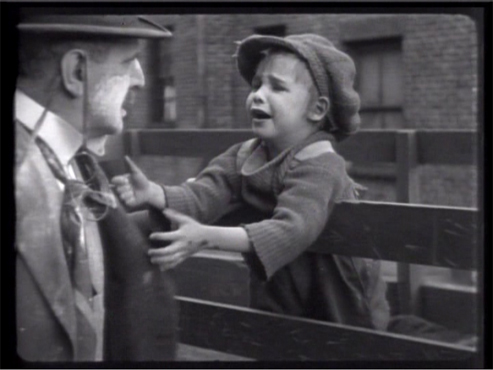
A distraught Jacki Coogan

Directed by Charlie Chaplin
Starring Charlie Chaplin, Jackie Coogan, Edna Purviance
Produced by Charlie Chaplin Productions

A new mother is evicted from the charity hospital. Her crime? Having her child out of wedlock. In desperation she leaves her son in the backseat of a car outside of a mansion. Maybe this rich family can provide a better life for her boy.

Unfortunately, the car is almost immediately stolen by a couple of criminals. They discover the child and leave him in an alley where our beloved tramp comes upon him. He tries to ditch the kid, but when he finds a note saying the baby is an orphan, he decides to raise the child himself.

Fast forward five years. The woman has become a famous star, but she does charity work hoping to find her abandoned child. As for the boy, he is living with the tramp, executing scams to make money.

Will the woman find her son? And what will become of the tramp?

Incredible.

Every aspect of The Kid is head and shoulders above every other comedy I have seen so far. A fantastic mix of comedy and drama that manages to make you laugh moments before yanking your heartstrings.

Jackie Coogan is remarkable as the title character.  His kid is wonderfully expressive and a terrific mimic of Chaplin.  But when he is abducted by the orphanage officials, his fear and terror are so palpable it kills you inside to watch. 

Chaplin is (of course) brilliant.  In many ways, he is underplaying his character compared to some of the other shorts he has done.  He's not as over-the-top zany as he has been.  The comedy is more grounded in reality which serves the story perfectly.

My favorite comedic moments?  I love the image of the baby in the makeshift hammock drinking from a coffee pot-turned-bottle.  I love Chaplin's con with the boy (the boy breaks windows, Chaplin comes along to repair them).  I love the fight between Chaplin and the kid and the bullies.  Sure, it's reminiscent of Easy Street, but the stakes here are higher.

What truly makes The Kid remarkable though is the moment when Charlie loses his ward.  The movie took the time to build their relationship through comedic and quiet moments and it pays off.  Charlie flips out and chases down the orphanage truck across the rooftops.  It's a spectacular sequence.

The film ends with an elaborate dream sequence where Chaplin's neighborhood is transformed into heaven.  All of its denizens except the Tramp now sport wings.  The kid is there and helps Charlie buy his own wings, but they seem to bug him.  Sin enters this world and ultimately Charlie falls for a woman he shouldn't.  He tries to get away, but the police shoot him out of the sky.  He awakens on the steps of his flat, being summoned by the police, not to be arrested, but to be reunited with his surrogate child and his mother.

The tramp has always been opposed to authority.  Here though, it seems the message is that the Tramp's love of the child can be something transformative.  The police who oppose him early on, ultimately deliver him and the audience to the happiest of endings.

***** out of *****
Read More
Posted in 1921, charlie chaplin, the kid | No comments

Thursday, 6 January 2011

The Affairs of Anatol (1921)

Posted on 17:50 by Unknown
Directed by Cecil B. DeMille
Starring Gloria Swanson, Wallace Reid, Wanda Hawley
Produced by Famous Players-Lasky Corporation

Anatol and Vivian are newlyweds with a problem: Anatol enjoys helping other women. Why is that a problem?  Because he ignores everything else in his life to help his charity cases.  Everything, including his wife.

When he meets a high school sweetheart who is selling herself for money, he has to save her. He cannot help it. Vivian is driven nuts by her husband and wants him to focus on his home life. She is even willing to relocate to the country to help remove the temptation.

Can Antol change his focus back to his wife? Or will he realize the error of his ways too late?

The Affairs of Antol has a pretty straightforward setup. Young husband focuses his attention on another woman. Wife gets frustrated with husband. Husband is exasperated that wife doesn't understand his desire to help a friend. Frankly, for much of the first act, I was bored.

Then, Antol loses it.

NOTE: A lot of spoilers follow, as I cannot really explain why I like this one without outlining the craziness of the scenarios. 

Anatol's childhood friend initially wants to begin a new life.  She tries to learn the violin and give up her jewels.  Ultimately, she can't change her ways and goes back to her sugar daddy and the partying lifestyle Antol is trying to save her from. So, Anton DESTROYS her apartment. I mean the guy breaks everything up to and including a grand piano. He goes insane.

From then on, the movie is full-on crazy. Vivian throws a party with a hypnotist who convinces her to start undressing in front of a room full of people (including her husband). There are some great visuals as we see the stream Vivian imagines she is crossing (hence the undressing) flowing through the room.  Anatol is mortified.

They move to the country and take a boat out on the river at exactly the moment another desperate woman who is attempting to drown herself because she stole from a local charity.  Not only does Anatol save her, but as Vivian goes for help, the man makes out with the woman.

The couple separates.  Anatol tries hanging at the night club, but discovers he needs his wife Vivian.  She returns from a night on the town with a mutual friend.  He demands to know what happened between the two of them, but Vivian isn't spilling.

In one final moment of desperation, Anatol has Vivian hypnotized.  She must answer one question asked by her husband truthfully before awakening.  Great little drama at the end.

The leads here are great in their roles and the direction is perfect without being showy.  The characters and scenarios presented are fantastical, but I was riveted.  It's a 90 year old movie and I had no idea where it was going next.  It almost reminded me of a Coen Brothers film.  The Affairs of Anatol is not for everyone, but its dark humor and extreme situations were enough to keep me engaged.
**** out of *****
Read More
Posted in 1921, cecil b. demille, gloria swanson, the affairs of anatol | No comments

Wednesday, 29 December 2010

The Haunted House (1921)

Posted on 04:25 by Unknown
Keaton's hands are glued to his pockets... don't ask.
Directed by Edward F. Cline and Buster Keaton
Starring Buster Keaton and Virginia Fox
Produced by Joseph M. Schenk Productions

Buster runs the teller window at the local bank, but he's not very good at it.  He tricks the time lock on the vault to help a pretty girl, gets himself caught in the vault door and pours glue all over his hands and the money he's distributing.  The latter incident actually helps foil a bank robbery.  Buster's hands are stuck in his pockets so he cannot "put 'em up," and when he finally tries to give the robbers the loot, it sticks to everyone's hands and feet. 

The robbers make their escape to a house they have rigged to appear haunted and frighten off the police.  Keaton, who is inadvertently blamed for the robbery, escapes and seeks refuge in the same house.  Can Keaton foil the robbers and clear his name?

This is my least favorite Keaton film thus far.  The opening with the glue has a couple of amusing moments, but is repetitive and not particularly inspired.  I did enjoy Keaton's solution for freeing his fellow employee from being glued on the floor.  Other than that, the first half is pretty dull.

The second half which takes place at the "haunted" house is marginally better, but still not as great as One Week or his work with Fatty.  There's an inventive gag with a staircase that turns into a slide, but frankly it's overused and wears out its welcome pretty quickly.  There's an incredible visual of the robbers assembling a body that comes to life that is really a sight to behold. The rest of the gags primarily involve the robbers running around the house in sheets.  Again, some smiles, but not many laughs.

There is a fun coda at the end as Keaton has a near-death experience and ascends the staircase to heaven, only to discover stairs have the same design as the haunted house.  It was a moment I saw coming, but still loved the execution of.

Keaton's previous comedies were funny and relentless.  The Haunted House is more amusing and tedious.  Still, I cannot wait to see more of his work.

**1/2 out of *****
Read More
Posted in 1921, buster keaton, the haunted house | No comments

Tuesday, 28 December 2010

The Sheik (1921)

Posted on 04:36 by Unknown
Don't make me angry...
Directed by George Melford
Starring Rudolph Valentino, Agnes Ayres and Ruth Miller
Produced by Paramount Pictures

Ahmed is a powerful Arabian sheik.  When he says jump, his followers say how high.  When he wants the casino to himself, the casino closes.  And when he wants Lady Diana in his harem, she'd best get in line with the idea.

Of course, Diana is a wealthy, independent Englishwoman and wants no parts of this.  Ahmed, not willing to take no for an answer, kidnaps the woman and makes her a servant.

Eventually, Omair, an enemy of Ahmed, decides he wants the woman for himself and HE kidnaps her.  Ahmed, now realizing he is in love with Diana, mounts an attack on Omair's stronghold to win the woman back.  Can Ahmed save Diana?  And will she reciprocate his feelings?

All right, first, let's talk about the good stuff.  There are a couple of action set pieces here that are well done, particularly Ahmed's attack on Omair's lair at the end.  It did a great job of ratcheting up the tension throughout and the final fight between Ahmed and Omar was great.

As to the rest, I didn't care for this one at all.

I came into The Sheik looking forward to my first dose of Rudolph Valentino.  He's billed as a magnetic personality that brought people back to his romantic adventures over and over again.  His name is synonymous with the male ideal.

For me, the dude simply has crazy eyes.  I mean look at this:


Or this:

Or this:

This is the way he looks throughout the entire movie.  If there's a reason for women swooning, I do not get it.  His acting took me right out of the movie for its running time.

In terms of story, this is borderline misogynistic.  At one point, he says he does not understand why making Diana suffer is not bringing him pleasure.  He forces her to wear certain clothes and serve him.  By the mid-point of the film, she has become subservient to him.  When the two profess their love at the end, you don't know if she's fallen for the sheik or if she's suffering from Stockholm Syndrome.

Finally, at the end of this film, just as you are about to have an interracial romance, it is revealed that Ahmed is actually European and was adopted by a Mideast sheik.  So it's no longer taboo for them to be together!  I am sure this was necessary in 1921, but it struck me as just silly.

I had high hopes for this one based on the reviews, but was ultimately disappointed.

** out of *****
Read More
Posted in 1921, rudolph valentino, the sheik | No comments

Monday, 20 December 2010

Destiny, or Der müde Tod (1921)

Posted on 06:04 by Unknown
The wall of Death's garden
Directed by Fritz Lang
Starring Bernhard Goetzke, Lil Dagover and Walter Janssen
Produced by Decla-Bioscop AG

Death has come to a small town for some real estate.  He's inquiring about the land next to the cemetery.  He's interested in planting a garden. After some deliberation, the town decided to sell to the stranger.  He surrounds his new garden with a 100 foot high wall with no visible way in.

A young, very-much-in-love couple comes to the town and eats at a local establishment.  The stranger sits at their table and watches them.  When the woman enters the kitchen for a moment.  When she returns, she finds that her fiance has left with the ominous man.

She runs to the garden, searching futilely for a way in.  Then, she sees the ghosts of the recently departed descending the hill toward the wall.  She sees her man.  The ghosts pass silently through the wall.

But the woman has a plan.  She creates her own near-death experience to gain access to the garden.  Death is surprised to see her as it is not her time.  She implores him to release her fiance as love is stronger than death.

The chamber of candles
Death is willing to negotiate.  See, he looks upon his job as a curse and if love truly could conquer death, he'd be free.  He leads the girl to a chamber of candles, each one representing a life.  When the flame dies, so does the person. 

He shows her three candles.  If her love can keep just one of the flames from being extinguished, she can have her love back.  Can she keep the candles lit?  And will Death honor his side of the bargain?

Destiny is a gorgeous film filled with big ideas about life and death and visuals to match.  Above is a description of the framing story, but there is a significant time spent with the lives of the people represented by the three candles.  Each of those individual tales is compelling, but my favorite was the third with its elements of magic and the supernatural.

The acting does what it needs to do.  The "stranger" played by Bernhard Goetzke provides the right balance of menace world-weariness.  The young couple (Lil Dagover and Walter Janssen) are very good in the framing story, but shine playing multiple roles in the three interior stories.

Gorgeous
But it's the visuals and story directed by Lang that make this film soar.  I love the wall surrounding Death's garden.  I love the chamber of candles.  I love the magic carpet and magic wand of the final tale.  A prison tower turning into an elephant with a cage on top?  Brilliant to watch.

My overall thoughts?  How has this not been remade?  It's gorgeous and full of ideas that were original in their time.  Terry Gilliam needs to get on this project stat!


***** out of *****


Watched on Netflix Watch Instantly
Photos from Six Martinis and the Seventh Art
Read More
Posted in 1921, destiny, fritz lang | No comments

Tuesday, 14 December 2010

1921: An End for Fatty

Posted on 04:17 by Unknown
1921.  World War I officially ends setting the stage for the 20s to roar.  Adolf Hitler becomes Fuhrer of the Nazi party, setting the stage for the next great war and a number of Indiana Jones adventures.  And in pop culture news, the first Miss America pageant is held in Atlantic City.

In film news, the big story was the fall of Roscoe "Fatty" Arbuckle.  After signing a contract with Paramount, Arbuckle threw a large party to celebrate in San Francisco.  A few days later, little known actress Virginia Rappe died.  Allegations swirled that Arbuckle sexually assaulted the actress.  It did not matter that he was never found guilty.  Media attention and sensational stories ended the career of one of comedy's biggest stars.


In other film news, Charlie Chaplin makes his first feature film, The Kid.  Heartthrob Rudolph Valentino begins his ascension to the ranks of leading men with The Sheik.  D.W. Griffith makes Dream Street, widely considered to be the first sound film.

What are watching?  The Kid and The Sheik for certain.  Griffith's Orphans of the Storm, Fritz Lang's Destiny, and Cecil B. DeMille's The Affairs of Anatol are all available on Netflix Watch Instantly.  I'm also going to try to see Henry King's Tol'able David and The Three Musketeers with Douglas Fairbanks.
Read More
Posted in 1921 | No comments
Older Posts Home
Subscribe to: Posts (Atom)

Popular Posts

  • Grass: A Nation's Battle for Life (1925)
    Put it on a postcard Directed by Merian C. Cooper and Ernest B. Schoedsack Produced by Paramount Pictures           Grass: A Nation's Ba...
  • Set Visit: The Patchwork Girl of Oz
    Posted April 1 1914 6:01:02pm Last week, I had the opportunity to visit the set of The Patchwork Girl of Oz , J. Farrell MacDonald's ada...
  • Gertie the Dinosaur and the Future of Animation
    Posted April 1, 1914 3:00:32 Earlier this year, Winsor McCay released the remarkable Gertie the Dinosaur , a painstakingly crafted two dimen...
  • A Lad from Old Ireland (1910)
    Anyone who knows me understands how this ended up as a selection for this adventure. A Lad from Old Ireland tells the simple story of an Ir...
  • Quantifying Cinemania: Summer 2013 vs. 2014
    So this article starts with a random thought.... A year and half ago, movie reviewers were focused on two summers: 2013 with Iron Man 3 and...
  • Baby Face (1933)
    Directed by Alfred E. Green Starring Barbara Stanwyck, George Brent and Donald Cook Produced by Warner Bros. For many of us, our job (or lac...
  • Wings (1927)
    Directed by William A. Wellman and Harry d'Abbadie d'Arrast (uncredited) Starring Clara Bow, Charles 'Buddy' Rogers and Rich...
  • The Private Life of Henry VIII (1933)
    Directed by Alexander Korda Starring Charles Laughton, Robert Donat and Franklin Dyall Produced by London Film Productions History and cultu...
  • 1931: We Build the Empire State Building (and Hope There Are No Large, Rampaging Apes Around)
    Welcome to 1931. We are at the height of the Great Depression. Over 2,000 banks are failing. Prices are dropping. Things generally suck.  ...
  • The Struggle (1931)
    Directed by D.W. Griffith Starring Hal Skelly , Zita Johann , Charlotte Wynters Produced by D.W. Griffith Productions  It's the early...

Categories

  • 12 angry men
  • 1910
  • 1911
  • 1912
  • 1913
  • 1914
  • 1915
  • 1916
  • 1917
  • 1918
  • 1919
  • 1920
  • 1921
  • 1922
  • 1923
  • 1924
  • 1925
  • 1926
  • 1927
  • 1928
  • 1928. john ford
  • 1929
  • 1930
  • 1931
  • 1932
  • 1933
  • 1959
  • 1977
  • 1984
  • 1997
  • 20000 leagues under the sea
  • A Fool there Was
  • a lad from old ireland
  • a natural born gambler
  • a sammy in siberia
  • Abraham Lincoln
  • Adolfo Padovan
  • aelita queen of mars
  • after tomorrow
  • akira kurosawa
  • al jolson
  • alan crosland
  • albert parker
  • Alberto Cavalcanti
  • Aleksandr Dovzhenko
  • alexander korda
  • alfred e green
  • alfred hitchcock
  • alfred santell
  • algie
  • alice comedies
  • alice guy
  • all quiet on the western front
  • all wet
  • amarilly of clothes-line alley
  • animal crackers
  • anna christie
  • another fine mess
  • another view
  • april1
  • archie mayo
  • are crooks dishonest
  • arsenal
  • artsfest
  • atlantis
  • baby face
  • bangville police
  • bankruptcy
  • barbara stanwyck
  • bardelys the magnificent
  • battleship potemkin
  • battling butler
  • beau brummel
  • bela lugosi
  • bell boy
  • beloved rogue
  • Ben-Hur: A Tale of the Christ
  • benjamin stoloff
  • berlin: symphony of a great city
  • bert williams
  • best picture
  • beyond the rocks
  • big business
  • birth of a nation
  • blackmail
  • blockbuster
  • blogathon
  • blood and sand
  • blue bird
  • boris karloff
  • bridge on the river kwai
  • brigette helm
  • broadway melody
  • broken blossoms
  • bugs bunny
  • buster keaton
  • butcher boy
  • captain america
  • captain fracasse
  • carl theodor dreyer
  • cecil b. demille
  • charles laughton
  • charlie chaplin
  • chess fever
  • china seas
  • Christmas Carol
  • christopher strong
  • cimarron
  • citizen kane
  • city girl
  • city lights
  • civilization
  • clara bow
  • clarence brown
  • clark gable
  • cleopatra
  • cobra
  • colin clive
  • college
  • conrad veidt
  • crash
  • d.w. griffith
  • daddy long legs
  • daughter of the gods
  • dead alive
  • decade wrap up
  • Defence of Sevastopol
  • destiny
  • disney
  • documentary
  • dorothy arzner
  • douglas fairbanks
  • dr. jekyll and mr. hyde
  • dr. mabuse
  • dracula
  • duck soup
  • dziga vertov
  • easy street
  • ed wood
  • edmund goulding
  • educational films
  • edward g robinson
  • edward s. curtis
  • edwin l marin
  • elmo lincoln
  • emil jannings
  • eric campbell
  • erich von stroheim
  • ernest b. schoedsack
  • ernest torrence
  • ernst lubitsch
  • eugene o'brien
  • evelyn brent
  • evgeni bauer
  • evil dead
  • exploitation films
  • f.w. murnau
  • famous players film company
  • fannie ward
  • fantastic four
  • fatty arbuckle
  • feline follies
  • felix the cat
  • film pasture
  • flesh and the devil
  • formative experience
  • four sons
  • fox film foundation
  • Francesco Bertolini
  • frank borzage
  • frank capra
  • Frank Powell
  • frankenstein
  • freaks
  • fred niblo
  • frederick warde
  • friday the 13th
  • fritz lang
  • g.w. pabst
  • gary oldman
  • gene gauntier
  • george archainbaud
  • george brent
  • george fitzmaurice
  • george loane tucker
  • george lucas
  • gertie the dinosaur
  • gloria swanson
  • godzilla
  • gold rush
  • Gone with the Wind
  • grand hotel
  • grass: a nation's battle for life
  • greed
  • green lantern
  • greta garbo
  • guilty generation
  • haldane of the secret service
  • harold lloyd
  • harry beaumont
  • haunted house
  • hausu
  • Henri Étiévant
  • henry king
  • Henry Lehrman
  • henry macrae
  • Henry Wulschleger
  • herbert marshall
  • hollywood
  • horse feathers
  • houdini
  • humor
  • i am a fugitive from a chain gang
  • i was born but
  • icon
  • in old arizona
  • in the land of war canoes
  • interracial romance
  • intolerance
  • irving cummings
  • it
  • J.Searle Dawley
  • jackie cooper
  • james cagney
  • james cameron
  • james cruze
  • james parrott
  • james w horne
  • james whale
  • james young
  • jean arthur
  • jean harlow
  • jeanette macdonald
  • jesse l. lasky
  • jesus
  • jim carrey
  • jim jarmusch
  • joan crawford
  • joel mccrea
  • john barrymore
  • john ford
  • john gilbert
  • john wayne
  • johnny weissmuller
  • Josef von Sternberg
  • joseph santley
  • josephine baker
  • just pals
  • just rambling along
  • katharine hepburn
  • keystone cops
  • kid auto races at venice
  • king kong
  • king lear
  • king vidor
  • L'Inferno
  • lamb
  • lammy
  • last of the mohicans
  • laurel and hardy
  • leaves from satan's book
  • leo mccarey
  • lewis milestone
  • liliom
  • lillian gish
  • lionel barrymore
  • little american
  • little annie rooney
  • little caesar
  • little nemo
  • Little Tramp
  • live flesh
  • lon chaney
  • lonely wives
  • looking back
  • loretta young
  • louise brooks
  • love parade
  • lucius henderson
  • luis bunuel
  • M
  • maltese falcon
  • man with a movie camera
  • manic pixie dream girl
  • Marc McDermott
  • Mario Nalpas
  • marion davies
  • marlene dietrich
  • marshall neilan
  • marx brothers
  • mary pickford
  • Maurice Tourneur
  • max fleischer
  • me and my gal
  • merian c. cooper
  • merry-go-round
  • mervyn leroy
  • metropolis
  • mgm
  • michael
  • mickey mouse
  • milestones
  • modern times
  • monkey business
  • monte carlo
  • mothra
  • movie theaters
  • mr. popper's penguins
  • murder
  • musketeers of pig alley
  • neil hamilton
  • netflix
  • never weaken
  • new york hat
  • nicolas cage
  • night of horros
  • Norman Z McLeod
  • nosferatu
  • not so secret santa
  • number please
  • off-topic
  • oliver hardy
  • oliver twist
  • one week
  • opry house
  • orphans of the storm
  • oscar apfel
  • oscar winner
  • oswald
  • otis turner
  • our hospitality
  • out of the inkwell
  • pandora's box
  • paramount
  • parody
  • paul leni
  • paul muni
  • pedro almodovar
  • Pennsylvania Board of Motion Picture Censors
  • peter lorre
  • photoplay
  • platinum blonde
  • podcast
  • police
  • poll
  • polly of the circus
  • private life of henry viii
  • propaganda
  • public enemy
  • Quantifying Cinemania
  • que viva mexico
  • queen kelly
  • racism
  • raging bull
  • rambling ramblers
  • ramblings
  • ran
  • raoul walsh
  • rebecca of sunnybrook farm
  • redbox
  • richard barthelmess
  • rmocj
  • rob reiner
  • robert florey
  • robert louis stevenson
  • robin hood
  • roger corman
  • rowland v lee
  • roy del ruth
  • rudolph valentino
  • russell mack
  • sadie thompson
  • safety last
  • saga of gosta berling
  • sally of the sawdust
  • salvador dali
  • samuel goldwyn
  • Scrooge
  • secrets of a soul
  • sergei eisenstein
  • serial bowl
  • Sessue Hayakawa
  • shakespeare
  • shallow grave
  • shameless self-promotion
  • sherlock holmes
  • sherlock jr.
  • shoulder arms
  • sidney lumet
  • sidney olcott
  • silent film
  • silver horde
  • siren of the tropics
  • skin game
  • slapstick
  • slumdog millionaire
  • soup to nuts
  • spencer tracy
  • spiders
  • spiders. fritz lang
  • squaw man
  • stan laurel
  • star wars
  • steamboat bill jr.
  • stella maris
  • stranger than paradise
  • study in scarlet
  • sunnyside
  • sunrise
  • super 8
  • svengali
  • tabu
  • tarzan
  • tarzan of the apes
  • tarzan the tiger
  • taxi driver
  • tess of storm country
  • that guy
  • the adventures of prince achmed
  • the affairs of anatol
  • the battle of the sexes
  • the bells
  • the big trail
  • the black cyclone
  • the black pirate
  • the blue angel
  • the cabinet of dr. caligari
  • the champ
  • The Cheat
  • the circus
  • the cocoanuts
  • the dark knight rises
  • the dinosaur and the missing link
  • the dream
  • the eagle
  • the floorwalker
  • the general
  • the haunted house
  • the heart of new york
  • the hunchback of notre dame
  • the iron horse
  • the jazz singer
  • the kid
  • the king of kings
  • the little american
  • The Lonedale Operator
  • the lost world
  • the love of jeanne ney
  • the love trap
  • the man who laughs
  • the mark of zorro
  • the miner
  • the mothering heart
  • the navigator
  • the oyster princess
  • the paleface
  • the passion of joan of arc
  • the phantom of the opera
  • the ring
  • the seven chances
  • the sheik
  • the sinking of the lusitania
  • the struggle
  • the temptress
  • the ten commandments
  • the thief of bagdad
  • the three musketeers
  • the three stooges
  • the tramp
  • the unchanging sea
  • the unknown
  • the wasp woman
  • the wind
  • the wonderful wizard of oz
  • Theda Bara
  • thomas edison
  • thomas ince
  • titanic
  • tod browning
  • tol'able david
  • top ten
  • toy wife
  • traffic
  • traffic in souls
  • trolley troubles
  • tropes
  • trouble in paradise
  • twilight of a woman's soul
  • two-lip time
  • un chien andalou
  • union depot
  • universal pictures company
  • victor halperin
  • victor heerman
  • victor sjostrom
  • vlog
  • w.c. fields
  • wallace beery
  • walt disney
  • walter huston
  • warner brothers
  • waxworks
  • way down east
  • we faw down
  • we sing poorly
  • what i learned
  • what price hollywood
  • what the daisy said
  • white zombie
  • why change your wife
  • william a. wellman
  • william austin. Clarence G. Badger
  • william powell
  • william wyler
  • willis o'brien
  • wings
  • winsor mcay
  • wizard of oz
  • woman in the moon
  • x-men: first class
  • yasuji murata
  • yasujiro ozu
  • young america
  • youtube

Blog Archive

  • ▼  2014 (16)
    • ▼  July (2)
      • Duck Soup (1933)
      • Quantifying Cinemania: Summer 2013 vs. 2014
    • ►  June (6)
    • ►  April (6)
    • ►  February (2)
  • ►  2013 (52)
    • ►  December (5)
    • ►  November (4)
    • ►  September (3)
    • ►  August (2)
    • ►  July (5)
    • ►  May (5)
    • ►  April (7)
    • ►  March (2)
    • ►  February (8)
    • ►  January (11)
  • ►  2012 (91)
    • ►  December (2)
    • ►  November (5)
    • ►  October (9)
    • ►  September (7)
    • ►  August (24)
    • ►  July (18)
    • ►  June (4)
    • ►  May (1)
    • ►  April (2)
    • ►  March (8)
    • ►  February (8)
    • ►  January (3)
  • ►  2011 (109)
    • ►  November (2)
    • ►  September (4)
    • ►  August (10)
    • ►  July (14)
    • ►  June (30)
    • ►  May (11)
    • ►  April (13)
    • ►  March (7)
    • ►  February (3)
    • ►  January (15)
  • ►  2010 (94)
    • ►  December (8)
    • ►  November (20)
    • ►  October (15)
    • ►  September (17)
    • ►  August (14)
    • ►  July (13)
    • ►  June (7)
Powered by Blogger.

About Me

Unknown
View my complete profile